CLINICAL DATA QUALITY IMPROVEMENT
Turning Clinical Data Exchange Challenges into Actionable Improvements
We perform clinical data quality analysis and improvement services for the Veterans Health Information Exchange. The team examines incoming and outgoing data in the Joint DoW / VHA Health Information Exchange (JHIE). Then they determine if data is being sent and interpreted accurately between the VHA and Oracle Health (OH), DoW, and community provider partners. Next, we analyze data exchange problems and perform a root cause analysis. The team engages with external and internal data exchange partners to help rectify the root cause of the data quality problems.
Data quality processes are crucial for improving patient outcomes. Our methodology is called Clinical Data Quality Usability Scale (C-DQUS®) which helps providers measure the usability of their data. We are currently establishing the criteria and metrics for a Clinical Data Quality Usability Scale (C-DQUS®).
C-DQUS® uses surveys, assessments, analytic tools, and measures to develop KPIs. These matrixes visually present the clinical data quality, highlighting both usability and patient safety improvement opportunities for your organization. JPSys' unique C-DQUS® projects incorporate technologies and C-DQUS® team implement a clinical data quality solution to evaluate data. Then the team provides the recommendations to create resolutions.
Based on the appropriate HL7 standards, recommendations may include:
- Terminology solutions
- Configuration solutions
- Business data flow and best practice alternatives
- Identification of root cause of the issues
- Document how to add value to the users across the health care ecosystem (e.g., administration, operations, regulatory, public health)
J P Systems' unique total Data Quality solution is not just a software utility which we install, but a holistic data quality improvement. Our team monitors your incoming data and helps you engage your trading partners. We deliver a comprehensive Data Quality solution that combines advanced technology with clinical, informatics, and interoperability expertise. We supply the exact skill mix you need, such as IT analysts, clinicians, data scientists, data quality analysts, and HL7 data standards experts such as CDA or FHIR® analysts.
Our multidisciplinary team proactively monitors incoming clinical data, identifies quality issues, and resolves root causes across the EHR ecosystem. By correcting missing, miscoded, and misplaced data, we improve interoperability, strengthen patient safety, support compliance, and enable better clinical and operational decisions. Organizations gain direct access to nationally recognized experts in healthcare data quality, clinical informatics, HL7, CDA, and FHIR standards.
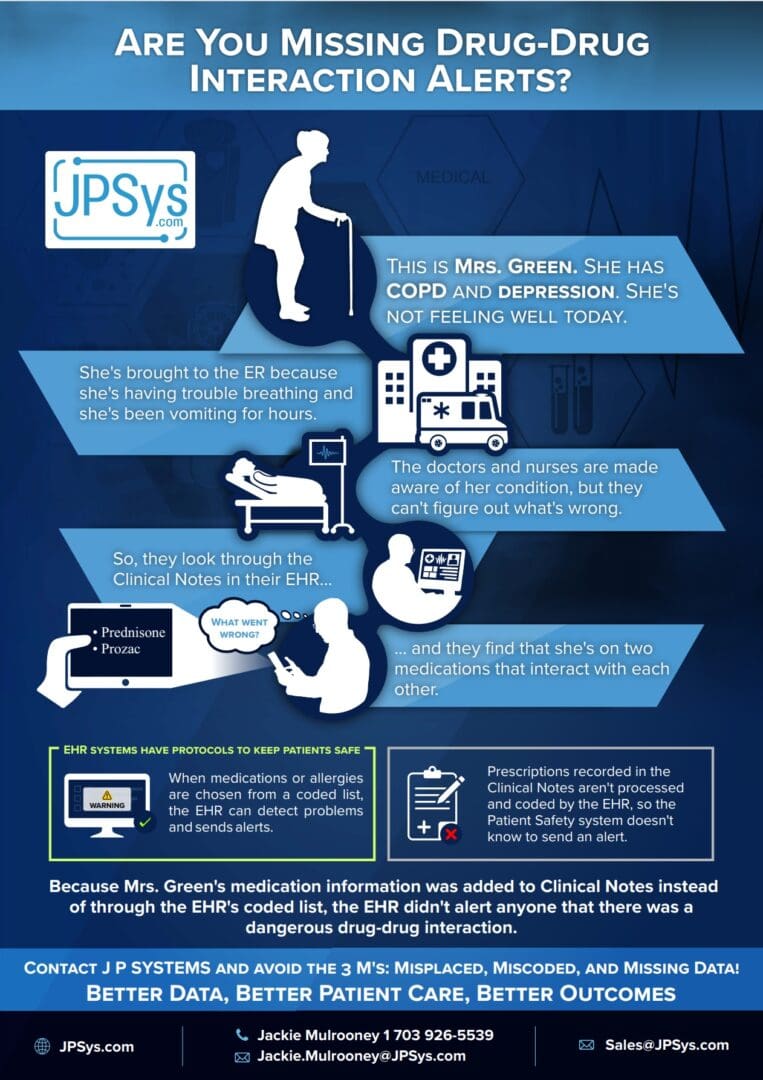
Data quality problems can sometimes be traced back to improper set up of your EHR system.
If your EHR system had prompted the user to enter RXNorm codes and NDF-RT codes were entered instead, then the critical drug - drug interaction checks will not execute properly. This is a critical risk and liability issue for all roles responsible for Risk and Data Quality. It is imperative that testing be done to ensure that this and all other patient safety protocols are working as the EHR vendor intended. We will work together with your vendor on such issues.
Your EHR system, such as Epic or Oracle Health creates standard HL7 clinical documents known as CDA files. These files have varying standard formats such as Continuity of Care Documents (CCDs) and other types. We have special tools which parse and look inside the CDA files to see if the data is being sent out correctly. We can identify if data is missing, mis-coded or in the wrong place. Then we provide you with a report of our recommendations for improvement.
Healthcare Data Quality and Interoperability
We meet with your staff to brief them on who should be in the meetings with our data quality team and decide how we access your data. Then once we receive your data, we kick off with an explanation of how we work and what we do. Next, we run our proprietary tools to create summaries of your most important domains (allergies, lab, etc.) for each of the CDA files which we receive. We provide a detailed report of six or more clinical domains to show you exactly where the problems are. Then you will know who to call and how to track down the source of the errors. The process repeats with the next set of files and domains.